

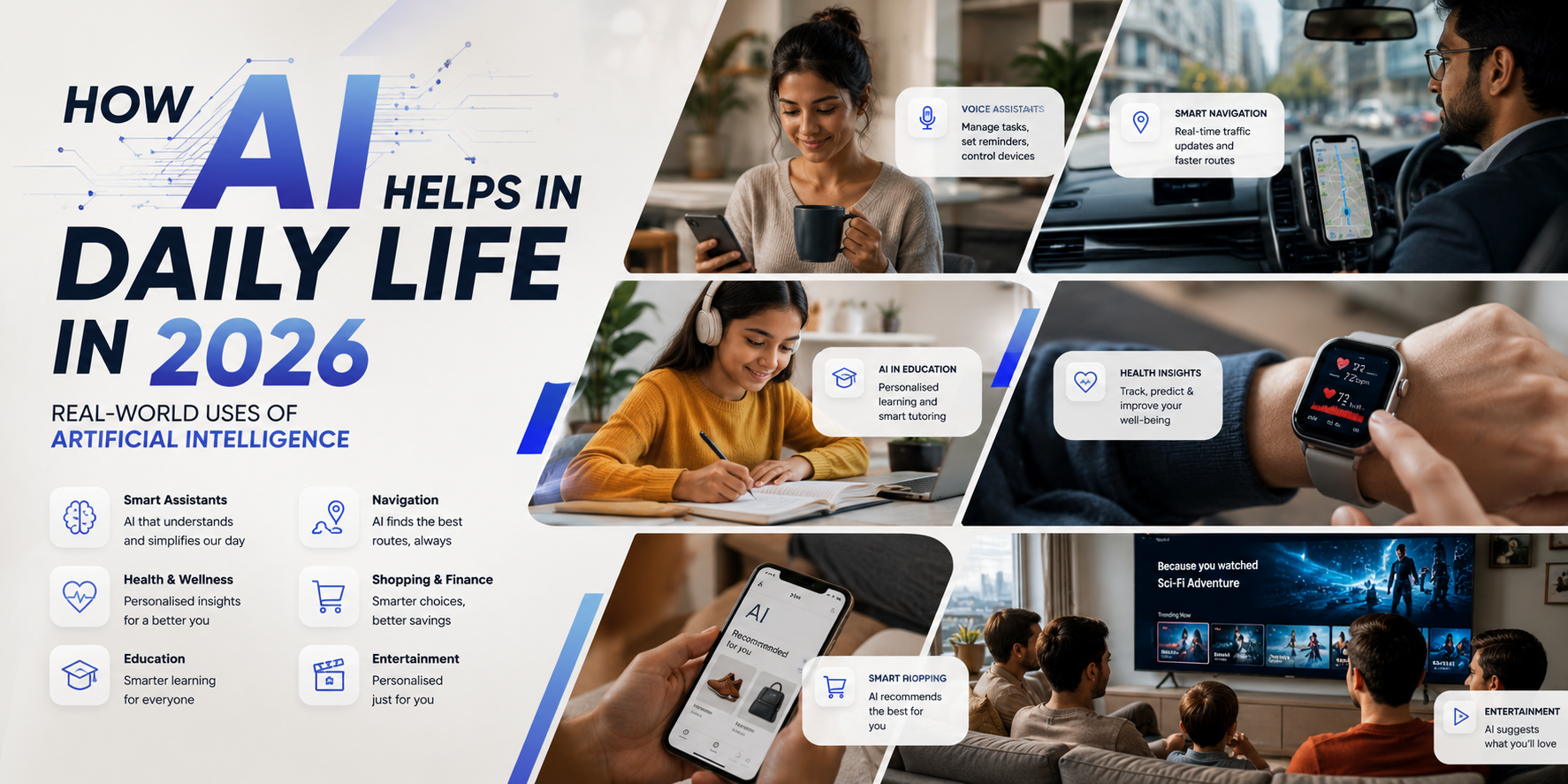
Artificial Intelligence (AI) is now one of the most powerful technologies shaping the modern world. In 2026, AI is not just sitting in research labs or within big tech companies anymore, it has more or less woven itself into daily life activities. You see it on smartphones, in online shopping, but also in healthcare, in education, and even inside business operations. It’s helping people save time , boost output , and make more clever decisions with a kind of quiet automation that feels almost ordinary.
There are many individuals that are interested in understanding what is Artificial Intelligence with examples, and how it works in real life. In simple terms, AI is defined as technology that allows computers and machines to analyze information, learn from that information through experience, recognize patterns within that information, and perform many of the functions associated with human intelligence. Currently, there are numerous applications of artificial intelligence all around us.
What is Artificial Intelligence? Understanding AI with Real Examples
Artificial Intelligence is a field within computer science that aims at making machines that can think, learn, and handle problems like people do. In practice, AI systems lean on sophisticated algorithms, machine learning, and data analysis, all together to get better results as time goes on.
Some common artificial intelligence examples include voice assistants like Google Assistant and Siri, recommendation systems on streaming platforms, smart navigation apps, facial recognition technology, and AI-powered customer support systems.
For example, when an online platform suggests products based on your previous searches or when a navigation app predicts the fastest route, AI is working behind the scenes to provide a better experience.
AI in Daily Life: How We Use Artificial Intelligence Every Day
The presence of AI in daily life has grown rapidly because it makes common tasks faster and more convenient. Many activities that people perform every day are supported by AI without them even realizing it.
Smartphones are maybe one of the biggest examples of how AI is used. Things like face unlock, camera upgrades, voice typing, spam detection, and tailored recommendations work because there’s artificial intelligence behind them. Basically, AI helps the phone sort of “read” what the person does—user habits and all—and then gives a more personalized experience, which feels smoother.
Another major area where AI is making an impact is online platforms. Streaming services, shopping websites, and social media platforms use AI algorithms to understand user preferences and recommend relevant content. This improves user experience and helps people discover products, videos, and information according to their interests.
Applications of AI in Education and Learning
Education is one of those industries where AI is opening up new opportunities, for both students and teachers, kind of in a sneaky yet helpful way. AI powered learning platforms can analyze how students are doing, spot learning gaps, and then give more tailored suggestions, not just generic ones.
Students can now use AI tools for research, learning concepts, improving writing skills, and solving complex problems. Teachers can also use AI to automate administrative tasks and focus more on teaching.
The growing use of AI in education shows why learning about artificial intelligence has become important for students who want to build future-ready skills.
AI in Healthcare: Improving Medical Services
Healthcare is another field where the applications of AI are transforming the way services are provided. AI helps doctors analyze medical reports, identify health risks, and support faster diagnosis.
AI-based systems can process large amounts of medical data and help healthcare professionals make more accurate decisions. Technologies like AI-powered imaging systems and virtual health assistants are improving patient care and making healthcare services more accessible.
AI in Business and Workplace Productivity
Businesses around the world are using AI to improve efficiency and make better decisions. From automated customer support to data analysis, AI helps companies understand customers and optimize their operations.
Many organizations use AI for marketing, sales forecasting, cybersecurity, and workflow automation. AI tools help employees complete repetitive tasks faster, allowing them to focus on more creative and strategic work.
For digital marketing professionals, AI has become an important technology for analyzing customer behavior, creating content ideas, improving campaigns, and understanding market trends.
AI in Transportation and Smart Technology
Transportation is another area where AI is creating significant changes. Navigation applications use AI to analyze traffic conditions and suggest better routes. Modern vehicles use AI features for safety assistance, parking support, and driver monitoring.
Smart home devices are also becoming popular because of AI. Devices that control lighting, security systems, and home appliances use artificial intelligence to understand user preferences and automate daily tasks.
Future of AI: Why Artificial Intelligence Skills Matter
The growth of AI is creating new career opportunities in technology and related industries. Skills related to artificial intelligence, machine learning, data analysis, and automation are becoming highly valuable.
As more businesses adopt AI solutions, professionals who understand AI technologies will have better opportunities in the future. Learning AI is not only useful for technology professionals but also for students, marketers, designers, and business owners.
Conclusion
Artificial intelligence has become a kind of crucial part of modern life, and its influence will keep expanding in the coming years. It is improving personal productivity while also transforming industries and somehow, in general, AI helps people work in smarter ways and arrive at better decisions.
Understanding AI in daily life, its benefits, and its real-world applications helps individuals prepare for a technology-driven future. In 2026, artificial intelligence is not just a future concept; it is already changing the way we live, work, and learn.
FAQs
1. What is Artificial Intelligence with examples?
Artificial Intelligence is a technology that enables machines to perform tasks that usually require human intelligence. Examples include voice assistants, recommendation systems, AI chatbots, and smart navigation apps.
2. How does AI help in daily life?
AI helps in daily life through smartphones, online recommendations, healthcare solutions, smart devices, navigation systems, and automated services.
3. What are the main applications of AI?
The main applications of AI include healthcare, education, business automation, digital marketing, transportation, cybersecurity, and customer service.
4. Is AI important for future careers?
Yes, AI skills are becoming important because many industries are adopting artificial intelligence for automation, analysis, and innovation.
5. How is AI used in businesses?
Businesses use AI for customer support, data analysis, marketing optimization, automation, and improving decision-making processes.