

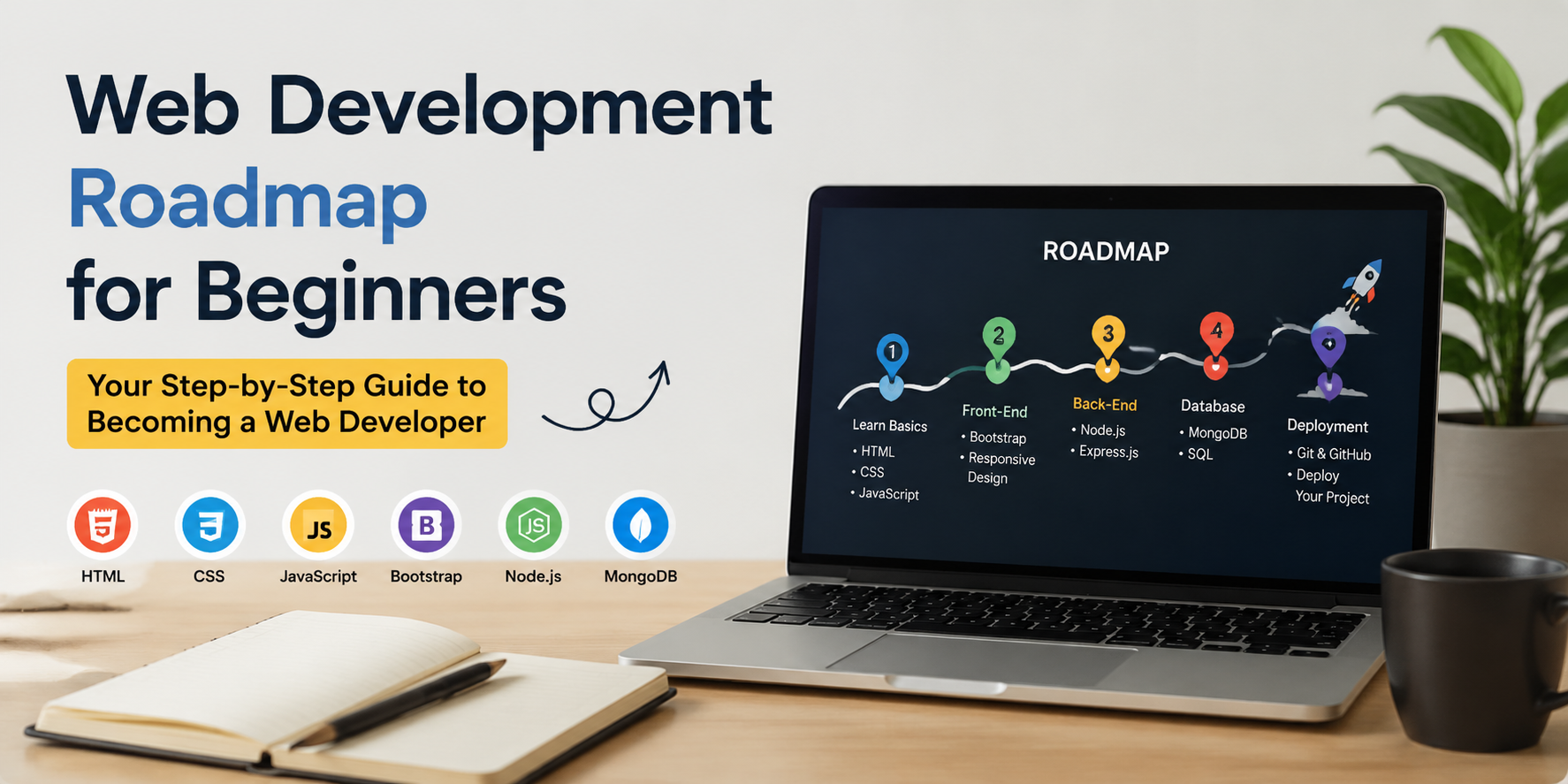
The technology industry is growing really fast, and web development has turned into one of those most popular career choices for students, beginners, and professionals who are aiming to build a successful future in the digital world. Almost every business today needs a website, or a web application, to connect with customers, to sell products, to provide services, or simply to create a solid online presence. Because the demand keeps rising, skilled web developers are getting more chances than ever before, like suddenly the doors are more open than before.
However, for beginners, beginning web development is overwhelming due to the plethora of languages, tools, frameworks, and technologies. Beginning developers frequently lack clear guidance on what they need to learn first, which skills are most valuable and how to progress from basic concepts to professional quality development.
This is where a kind of decent web development roadmap for beginners ends up being useful. Like, having a clear plan helps you see the right sequence of learning, and it also stops you from wasting time on random technologies, just with no proper direction. Honestly it kind of keeps things organized in your head, even if you start a bit scattered at first.
Understanding Web Development and Its Importance
Web development is basically the process of making websites ,and also web applications so they actually run on the internet. It usually covers sketching out the layout of a site, adding touchable interactive bits, handling data collections like databases, and then building the whole set of systems that lets a website work properly in the real world.
A website that you visit every day, whether it’s an online shopping marketplace, a social media platform, or a corporate business page , is built with different web development technologies. Behind every good-looking site, there’s usually some mix of coding, layout work, logical thinking , and problem solving. It’s kinda like all those pieces are glued together so the whole thing actually works.
A web developer is accountable for transforming concepts into practical digital products. They use various programming languages, frameworks, databases, and other tools/development to develop a seamless user experience.
Before you even start your journey, it’s kinda important to grasp that web development isn’t really about learning just one single language. It’s more like a whole process, where you step by step pick up different tools , different technologies and then you actually apply them using real, practical projects.
Starting With the Foundation: HTML, CSS, and JavaScript
Every successful developer begins with the basics. HTML, CSS, and JavaScript are the foundation of modern web development. These three technologies are the starting point of every beginner’s journey.
HTML is what people use to set up the basic structure of a web page. It kind of lets developers drop in different parts like headings , images, paragraphs , buttons, forms, and also links. And yeah, without HTML, the webpage can’t really have a good, ordered structure in the first place.
After you understand HTML, the next thing is learning CSS. CSS, basically, is what makes a website look visually good, not just functional. It handles colors, the layout, padding and spacing, the whole motion—like animations—and well, the design overall. If you grasp CSS properly, you can build pages that look professional, and they usually behave smoothly across different devices too.
Websites are brought to life with JavaScript. Developers can use it to enhance their website with interactive features such as animations, dynamic content, forms, and user interaction. Mastering JavaScript will prepare you for the remaining development phases of your program.
These three technologies are the most important part of any web developer roadmap because almost every modern website depends on them.
Learning Frontend Development for Creating User-Friendly Websites
After understanding the basics, beginners should move towards frontend development. Frontend development focuses on the part of the website that users directly interact with. Everything that users see on a website, from buttons and menus to layouts and animations, comes under frontend development.
Today, front-end development involves more than just creating a website with plain HTML, CSS and JavaScript. In addition to these core languages, developers now build web applications and websites using frameworks and libraries. Frameworks like React, Angular and Vue have become very popular due to their ability to help speed up the development process and keep it organized.
Of the various technologies available, many developers prefer to use React because it provides the ability to develop reusable components and can be used to create large-scale applications. Learning a frontend framework will help new developers see how professional applications are created in real life when they start working on actual projects.
A strong frontend skill set is an important part of the web development learning path because companies need developers who can create websites that are attractive, responsive, and easy to use.
Understanding Backend Development and How Websites Work Behind the Scenes
Many beginners only focus on designing websites, but professional web development goes beyond what users see. Backend development manages everything that happens behind the website.
The back-end handles all aspects of a website, including managing its servers, applications, databases (for data storage), authenticating users, processing data submitted by users, and ensuring the proper functioning of the website. When you log into the website, it is processed by the back-end to verify your credentials and manage your user account.
There are different technologies used for backend development, like Node.js, Python , PHP, Java, and some other programming languages too. For beginners it is not necessary to learn every single thing at once, even if it sounds appealing at first.
Backend knowledge helps developers build complete applications instead of only designing webpages. This is why backend development is an important stage in the complete web dev roadmap.
Learning Databases and Managing Website Data
Almost every website needs a place where information can be stored and managed. This is where databases come into the picture.
Web developers use databases to store information such as user profiles, product details, messages, and other important data. Understanding how databases work helps developers create powerful and reliable applications.
Popular databases include MySQL, PostgreSQL, and MongoDB. Beginners should learn basic database concepts such as storing data, retrieving information, and connecting databases with websites.
Database knowledge makes your development skills stronger and helps you move towards becoming a complete web developer.
Building Real Projects to Improve Your Skills
Learning theory is important, but practical experience is what actually improves your development skills. Many beginners spend months watching tutorials but do not build projects. This slows down their growth.
Projects help you understand how different technologies work together. Beginners can start with simple projects such as portfolio websites, landing pages, blogs, calculators, or small business websites. As skills improve, they can move towards advanced projects like e-commerce platforms, dashboards, and complete web applications.
Building projects also helps you create a portfolio that can be shown to recruiters and clients. A strong portfolio often matters more than only having certificates.
Practical project experience is one of the most valuable parts of the web development roadmap for beginners because it prepares you for real-world development challenges.
Learning Git, Deployment, and Professional Development Skills
Professional developers use tools that help them manage and share their code. Git and GitHub are two important tools that every beginner should learn.
Git helps developers track the changes in their projects sort of step by step, while GitHub lets them keep and share that same work online, in one place. A lot of companies end up looking at GitHub profiles during hiring , so if someone keeps their projects there up to date it can actually boost career prospects and opportunities.
Along with coding skills, beginners should also start learning how to deploy websites online, because it kind of completes the whole story. If they understand hosting, domains, and the deployment platforms , they can push the work through from building the website in the first place to actually making it available for people to use.
Final Thoughts on Starting Your Web Development Journey
Becoming a web developer requires patience, practice, and continuous learning. Technology changes quickly, so developers need to keep improving their skills and learning new tools.
If you follow the proper web developer roadmap it really helps new people build a solid base and then move, bit by bit, into real professional development. Don’t try to grab everything all at once, instead aim for grasping the concepts deeply, do regular practice, and keep constructing actual projects. Once you do that the whole process feels more fluent and less stressful.
Many career paths within web development are available through an appropriate web dev education and career development plan. Some examples of such career paths include frontend web developer, backend web developer, full-stack web developer, and freelance web developer. Having the dedication and continuing to practice regularly will help you to follow the web dev roadmap provided below, and successfully create a career in web development as a result