

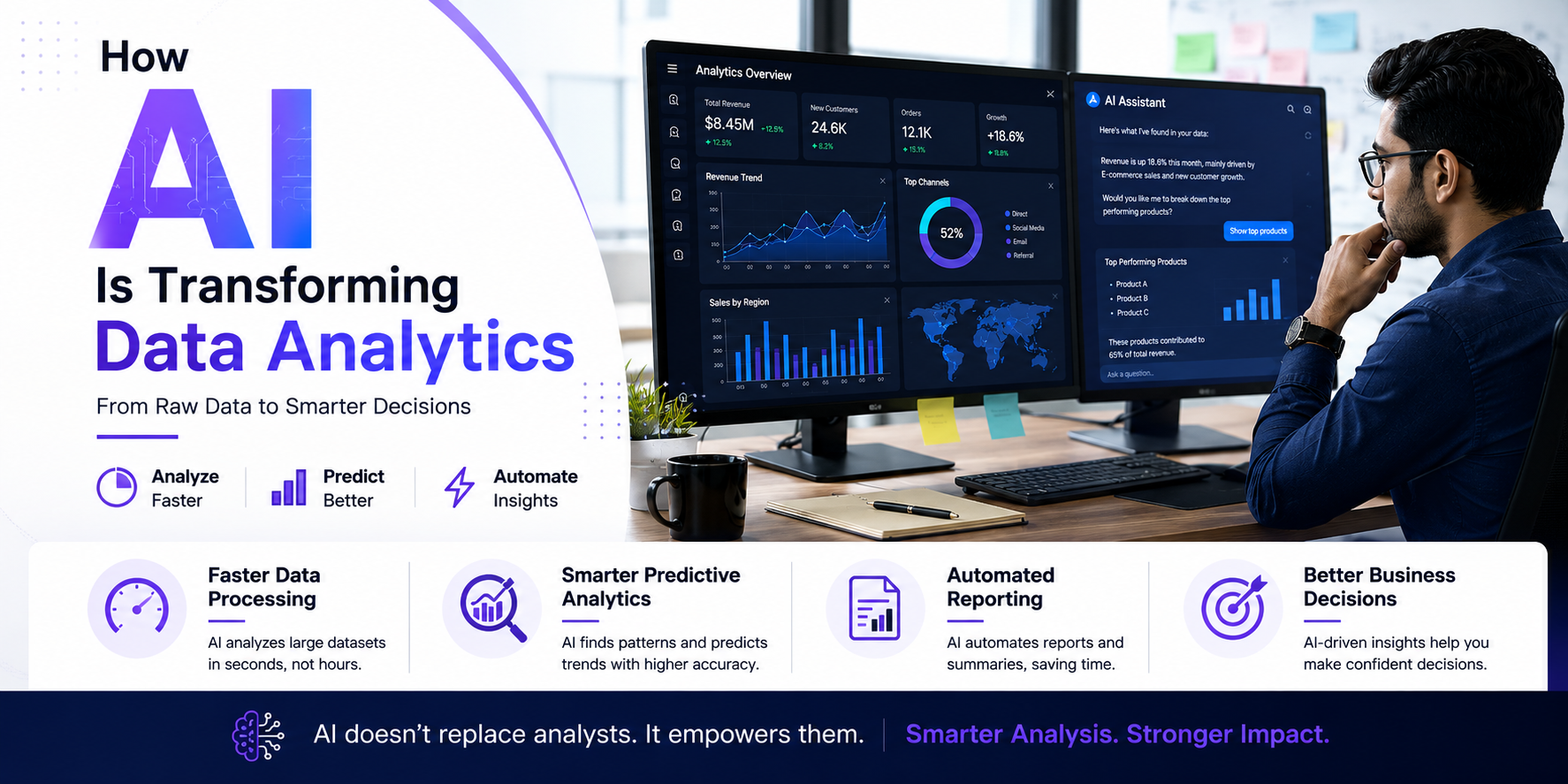
In today's digital space , businesses end up making huge amounts of information every second, like customer talks and website visits too, but also sales notes and social media engagement, honestly it all piles up. Organizations are kinda surrounded by data all day long. But gathering that information is only the initial bit. The real trouble is figuring out what it actually means, and turning it into useful insights that you can act on. And that's where artificial intelligence is kind of changing the whole game, because it helps connect the dots in a way people can miss, or at least it does it faster and with more focus.
The combination of AI and data analytics is helping businesses deal with huge amounts of info much faster, spot patterns more clearly, and move toward smarter decisions. What used to take a whole group of analysts, working for days—now can be done in a few minutes, mostly by systems that think in a practical way. Those systems use machine learning together with automation, and they basically shorten the time between questions and answers.
As industries keep leaning into digital transformation, artificial intelligence is slowly but surely getting treated as, like, a core part of modern analytics strategies. Organizations that manage to fold AI into their analytical workflows tend to pull ahead in a real competitive way, mostly because they can expose useful insights that might otherwise stay out of sight, or remain kinda tucked away.
The Evolution of Data Analytics
Traditional data analysis has always kinda leaned on looking at past information, you know, to figure out patterns and help decisions along. Usually, analysts gather the data, clean it up, sort it out, and then lean on statistical methods to craft reports. It works, sure, but the whole chain can take a while, and it also needs a lot of human effort, more than you’d expect sometimes.
The arrival of data analytics and artificial intelligence has sorta changed this way of doing things. Rather than just depending on manual analysis, organizations can now use clever, automated algorithms that figure out patterns , spot odd anomalies and even come up with predictions. And because these systems keep learning from fresh information , they tend to become more accurate as time goes along, which is kind of the point really.
This shift has kinda allowed businesses to move past basic descriptive analytics and slide into predictive, prescriptive analytics, so they can anticipate what might happen down the line, as well as suggest optimal actions that they should take.
How AI Enhances Data Processing
One of the more significant advantages of AI is how it can handle enormous data sets, quickly ,and fairly efficiently. Today a lot of organizations run into millions of records that for humans would be basically impossible to assess by hand, not really in any reasonable time.
With data and AI working together, companies can help automate data preparation, remove inconsistencies, and sort information in real time—like it’s always on. Artificial intelligence systems can also spot duplicate entries, fix mistakes, and standardize datasets, without needing a whole lot of human involvement, not even that much most of the time.
This automation cuts down on the day to day operational costs while boosting accuracy too. So analysts are able to focus on interpreting those insights and shaping strategies, instead of spending countless hours cleaning data, and, well, chasing the same rows over and over.
Predictive Analytics and Future Forecasting
Predictive analytics is one of the most useful applications of artificial intelligence in modern business. By looking at older patterns and what’s happening right now, AI systems can try to guess future results with pretty remarkable accuracy, and sometimes almost too well.
For example , retailers can sort of forecast customer purchasing patterns , financial institutions can gauge credit risk , and healthcare providers can point out possible health worries before they turn into serious problems . The whole integration of AI data analytics helps organizations to make more forward minded choices instead of just reacting to events after they happen .
These predictive capabilities help businesses reduce uncertainty and improve planning across various departments, including marketing, operations, finance, and customer service.
Real-Time Decision Making
Speed is critical in today's competitive business environment. Organizations must respond quickly to changing market conditions, customer demands, and emerging opportunities.
Traditional reporting methods are kinda slow, because data has to be collected, processed , and then reviewed before decisions can actually be made. But with AI and data analytics, you get sort of real-time insights , so businesses can respond right away instead of waiting around for the usual cycle.
For instance e-commerce platforms can tune product suggestions based on what the customer is doing, in real time, right when it happens. Likewise financial institutions are able to watch transactions continuously, to catch suspicious behavior quickly and help stop fraud.
The ability to make informed decisions instantly is becoming a key differentiator for successful organizations worldwide.
Improving Business Intelligence
Business intelligence has evolved in a pretty dramatic way since artificial intelligence came in. These days most BI platforms rely on AI-powered tools, to inspect those pretty complex datasets, and then spit out the insights in a format that’s easier to grasp for humans. It’s almost like the dashboards do some of the thinking.
Through advanced visualization techniques, organizations can fairly quickly spot trends, keep track of performance metrics, and sort of uncover hidden opportunities. The mix of data analytics and AI lets executives and managers reach usable insights, without needing a whole bunch of technical know how. In practice it feels like everything becomes clearer, even when the data is messy, and decision making gets less tedious.
This democratization of data allows decision-makers at every level of an organization to use information effectively and contribute to business growth.
Personalization Through Intelligent Analytics
Customers today sort of expect personalized experiences, across every digital platform, like all the time. Artificial intelligence does a lot here by helping organizations, understand customer preferences in a deeper way and then deliver relevant content, products and services. In other words it kind of guides what comes next, based on what each person seems to want.
By analyzing browsing history, purchasing habits, demographic information, and engagement behavior , AI systems end up making really accurate customer profiles. This kind of data analytics and artificial intelligence makes it possible for businesses to do more nuanced marketing outreach, suggest products, and generally raise customer satisfaction .
Companies such as streaming services, online retailers, and social media platforms rely heavily on AI-driven analytics to provide personalized experiences that increase engagement and loyalty.
Enhancing Data Security and Fraud Detection
As organizations gather more information, protecting that data becomes more and more important. Cybersecurity threats keep evolving, and traditional safety measures end up being insufficient in a lot of cases.
Artificial intelligence helps organizations detect unusual behavior and potential security risks before they cause significant damage. By continuously monitoring network activity and transaction patterns, AI systems can identify anomalies that may indicate fraud or cyberattacks.
When data and AI are put together in security operations, organizations can kind of respond quicker to threats, while still reducing the false alarms that pop up too often. It’s a more proactive way of working, which in turn makes the whole data protection posture stronger , and it also helps keep customer trust around, like it’s actually maintained and not just assumed.
Challenges and Considerations
Despite its many benefits, implementing AI in analytics comes with certain challenges. Organizations must ensure data quality, maintain transparency, and address ethical concerns related to automated decision-making.
AI systems are only as effective as the information they receive. Poor-quality data can lead to inaccurate insights and unreliable predictions. Businesses must also invest in skilled professionals who understand both analytics and artificial intelligence technologies.
Additionally, organizations should prioritize responsible AI practices by ensuring fairness, accountability, and compliance with privacy regulations.
The Future of AI in Data Analytics
The future of AI data analytics looks incredibly promising. Advances in machine learning, natural language processing, and automation will continue to enhance analytical capabilities across industries.
As technology evolves, AI systems will become even more sophisticated, enabling organizations to analyze unstructured information such as images, videos, and text with greater accuracy. Businesses will gain deeper insights, improve operational efficiency, and create more personalized customer experiences.
The growing relationship between AI and data analytics is expected to drive innovation in healthcare, finance, manufacturing, education, retail, and countless other sectors. Organizations that embrace these technologies today will be better positioned to compete in the data-driven economy of tomorrow.
Conclusion
Artificial intelligence is fundamentally reshaping the way organizations collect, analyze, and use information. The integration of data analytics and AI has transformed traditional analytical processes by introducing automation, predictive capabilities, real-time decision-making, and enhanced business intelligence.
From helping with day-to-day process speedups to providing those more tailored customer experiences, the influence of data analytics and artificial intelligence keeps getting broader across industries. Like, as companies keep creating really huge amounts of information, the part that data and AI play will matter even more, frankly.
Organizations that put their money into modern analytical technologies and start embracing AI data analytics, will be able to pull out deeper insights, make smarter decisions and eventually reach sustainable growth in a marketplace that is getting more and more competitive each year.