
Python Projects for Beginners
Explore the best Python projects for beginners, Python mini projects, and Python projects with source code to build coding skills with real examples.
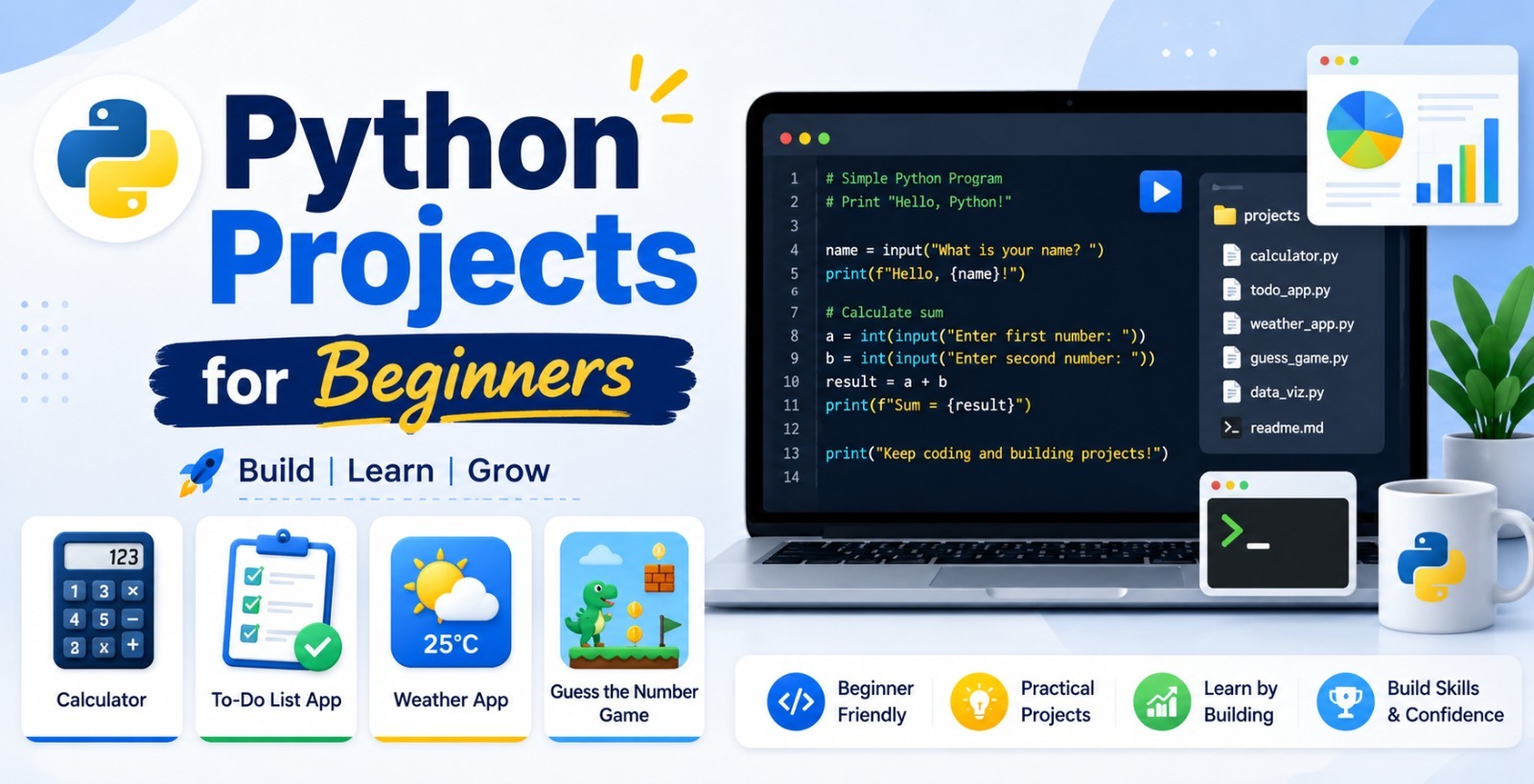
Finishing a Python course feels great for about two days, and then the same question shows up for almost every beginner: okay, but what do I actually build now? It's the most common wall people hit, and tutorials rarely warn you about it. Knowing what a for loop does, and actually using one to solve a problem you've never seen before, are two very different skills. That's the real reason python projects for beginners work better than watching one more video. You stop consuming and start deciding things yourself, which is where the learning actually happens.
Here's a real list, not the usual "build a calculator" one-liner repeated everywhere, but with the exact module each project uses and what it drills into your head once it's done. Most python projects at the beginner stage look small and forgettable on their own, but each one hands you a piece you'll reuse later without even noticing.
Start With These
A calculator is still the right place to begin, not because it's exciting, but because handling the divide-by-zero case properly is what forces try-except to actually make sense instead of just being a rule you read somewhere. Once that's done, a random password generator using Python's built-in random and string modules is a natural next step. Combine letters, digits, and a few symbols, and the script ends up genuinely useful, most people keep using it for their own passwords long after finishing it.
A dice rolling simulator and a number guessing game both lean on that same random module, but they teach different things. The dice one is mostly about keeping a function clean and simple. The guessing game is where while loops and conditionals click, since the program keeps checking user input until it matches. Rock-Paper-Scissors is a nice jump after both, because it's usually the first project where a dictionary makes more sense than another chain of if-elif statements to decide a winner.
One more worth adding here is a contact book: names and phone numbers stored in a dictionary, with a way to search or update an entry. It looks unremarkable on paper, but it's one of the more useful python mini projects because it's the first real practice with key-value data, which shows up in almost every application built afterward.
A Notch Harder
A to-do list that runs from the terminal is a natural next python project, and it's also where file handling stops being optional. Add tasks, mark them done, delete them, and save everything to a text file so the list survives after the program closes. That single feature, saving to a file, is really the whole point of building it.
An expense tracker works the same way conceptually, just with numbers instead of text: log an amount, tag it with a category, keep a running total. Later, plotting that data with matplotlib is an easy add-on for anyone curious where the money actually goes. A unit converter or a BMI calculator are quicker builds, but they're worth doing anyway, since they teach input validation, users will type things no one expects, and the code needs to handle it without crashing.
Then there's the QR code generator, built with the qrcode library. It takes barely fifteen lines, yet it's consistently one of the most searched python projects with source code, largely because installing an external library for the first time and getting it to actually work feels like a genuine milestone.
Projects That Feel Like Real Software
A weather app pulling live data from a free API like OpenWeatherMap is where things start feeling closer to real software. The requests library handles fetching the JSON, and pulling out the temperature and conditions is usually the moment API integration stops sounding intimidating. Right after that, a file organizer using os and shutil that sorts a Downloads folder into Images, Documents, and Videos isn't just an exercise, it's something people tend to keep running long after the project is technically "done."
A small library management system built on SQLite3, using Python's sqlite3 module, rounds this section off well. Books, issue dates, return dates, all stored properly instead of vanishing the moment the script closes. Of everything on this list, this is the single python project that shows the most on a resume, because it proves comfort with a database, not just variables held in memory.
Reading Someone Else's Code Without Just Copying It
Searching for python projects with source code is useful, but only when the code gets read, not just copy-pasted and run. Opening the file, finding the function that decides a winner or validates input, and asking why it was written that way teaches something copying never will. Closing it afterward and trying to rebuild that one piece from memory is what actually locks the logic in, since rebuilding forces real thinking while copying only shows the answer.
Building Momentum, One Small Win at a Time
For anyone short on time, stringing together a handful of python mini projects, dice roller, password generator, QR generator, unit converter, across a few weekends works well. None of them look impressive alone. But five or six sitting in one GitHub folder tell a recruiter something a single half-finished ambitious app never will: that the person actually finishes what they start.
Whichever python project comes first, a short README explaining what it does and why it was built is worth the two minutes it takes. It's a small habit, but it's the difference between a random script and something worth showing another developer. Enough of these python projects, even the small ones, and the "what do I build next" question stops coming up at all.
 Graphics Design and Video Editing Course for Beginners (1).png)
.webp)