
How to Become a Data Analyst: Skills, Steps & Career Guide
Learn how to become a data analyst from scratch. Discover the essential skills, tools, learning steps, and career opportunities for beginners.
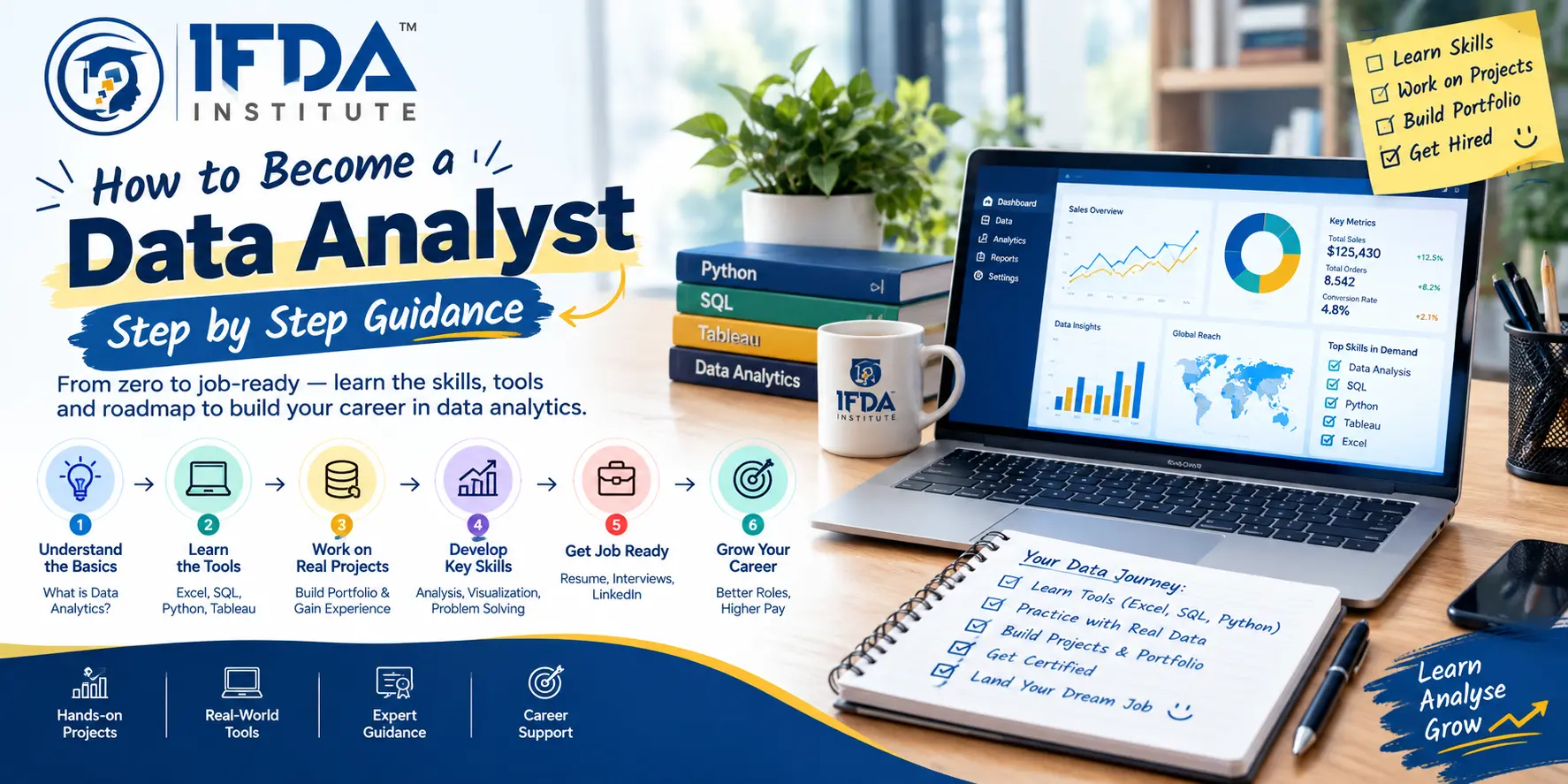
Many thousands of fresh graduates enter the market with a degree every year, but many of them don’t realize that after graduation, getting a good, satisfactory career may be hard As most companies are seeking out employees equipped to make use of modern technology, examine info, and remedy down-to-earth enterprise trouble.Due to these reasons, data analytics has grown to be an engaging career choice for freshers, graduates, and professionals. However, if you are seeking to begin from scratch, then one question immediately arises in an individual's mind: How do I grow to be a data analyst?The good information is you don't need to recognize every element from the first day. All that matters is that you're adopting the correct studying plan, building handy capabilities on each step, and finding the good way to get you to the point of know-how.
1. Understand What a Data Analyst Is
Even earlier than you discover how the specified tools need to be used, make sure that you know what exactly a data analyst is.
In easy terms, an information analyst is a person that analyzes the statistics gathered by using the information by a corporation and extracts vital patterns, insights, and trends in an effort to improve a corporation's efficiency. For instance, to comprehend how sales have fallen lately, which product merchandise is most excellent, and what kind of customers are investing maximum money. Then the data analyst examines the info he has and gives an investigation, based on which a boss can find out about some better business decisions.
So, data analytics is not merely about numbers but instead about using records to resolve issues.
2. Begin with Excel
For anyone who's absolutely new to information analysis, it's important that you're trying out Excel to gather awareness about it. It may be one of the most crucial steps so that it will assist learners in perceiving how facts need to be arranged, managing record sets, filtering facts, analyzing reports, and constructing primary data and charts. These abilities assist you in making statistics sensible earlier than you get to the more modern-day techniques of analytics.
It isn't essential to come to be an Excel guru properly right away; you can start off with an important understanding and pass it on as you begin coping with enormous actual data sets.
3. Find Out SQL
Once you feel at ease with organizing facts, it's time to begin discovering the use of a database for records evaluation by acquiring know-how of SQL (Structured Query Language). As many companies are seeking to keep records, they'll be seeking out a person who could study databases to locate the info they're wanting. You must start with primary concepts of finding out the database that also consists of sorting, filtering, grouping the results, etc., along with an insight of functions including JOIN.
4. Become Good at Data Visualisation
Once you've found some valuable info hidden in a dataset, you have to be able to tell people what you've found. That's why data visualization skills are paramount. Power BI and Tableau, for example, are tools analysts use to build dashboards, charts, and reports so that stakeholders can easily understand the data.
A good dashboard isn't a collection of charts and diagrams but one that delivers key insights clearly.
5. Master Python Data Analysis
Python programming is a very useful programming language for all future data analysts. Python is another language to be proud of in a data analyst's CV. You do not need to be a professional coder or programmer to start; you can just go with basic programming in Python and then learn from there using various data analysis libraries like pandas, numpy, and so on. Python data analysis will allow you to clean, analyze, or explore data more proficiently.
6. Practical, Real-World Projects
Make your data learning process more purposeful. You can start working on real-world projects instead of finishing online courses without practicing what you've learned. You can create sales reports, analyze customers' performance, study market research, etc.
These will let you get the hang of working with different types of real-world datasets for various kinds of real-world applications.
7. Enroll in a Data Analytics Course
Learning everything on your own might be a challenging experience, particularly when you do not know where to start.
A proper data analytics course can lead you through the necessary skills, such as Excel, SQL, statistics, data visualization, Power BI, Python, and more, with a structure.
If you are considering a data analyst course near you or looking for a data analyst course in Delhi, then check out the curriculum very well. Pick a course with good trainers, updated tools, and practical applications rather than one only because they give a certificate.
8. Develop Your Problem-Solving Abilities
The second key part of being a great data analyst is not your knowledge of software but instead your ability to look at a problem in a logical way, to ask the right questions, to find information that is useful, and then to communicate the conclusion effectively. For example, in sales declining, there should not be just a notification saying sales dropped; it should find why and what the business could do now.
9. Prepare Your Interviews
Now that you have worked hard to enhance the skills mentioned above and you have your projects, start preparing your interviews. Revising the basics of Excel and SQL, training with different data interpretation questions, having basic statistical concepts, and understanding how to explain your work. Moreover, the interviewer wants to know about how you approached a specific problem or why you took a particular method and explain why it can be just as vital as having the solution.
10. Continue to Learn and Train
This career is an area you never really stop training at because as the software is developing, the business sectors are also developing by adapting new tools or how information is accessed through different analysis processes. Do not be a perfectionist by wanting to learn it all at the same time, but aim at developing yourself on each skill one at a time and continue practicing by working through other data sets and continuing to develop a more advanced portfolio.
Get the Appropriate Method to Build Yourself Up as a Data Analyst
Knowing the way to know how to become a data analyst doesn't mean anything; it is just the start of something else, but it is about what you will do after you know it all. Be it that you are a fresh graduate having started your first job, looking for jobs, or a professional working person from a non-IT sector that is deciding to be in an IT career, just be familiar with all the basic processes and do develop yourself in steps that are small. Familiarity with Excel and learning to query data using SQL are essential steps; exploring how the data would be seen (visualization) and getting hands-on with some tools of data analysis or scripting (Python) are crucial.
Having a professional and practical approach by undertaking a proper data analysis course would help you to complete the journey successfully, but you need to be familiar with regular trainings to get good results at it.
Our primary goal must not just be to get certificates but instead to learn and analyze data, solve problems, and be confident enough to report what you find.
Conclusion
It does not imply a complex journey to develop your skills as a data analyst, and knowing what and how you need to learn them is basically the same path to acquiring them. Learn to start with very basic steps, then proceed, and always continue to develop them through various exercises/projects. Therefore, as an ideal beginner who seeks a data analyst career path, learn those basic concepts and the method of analysis while practicing on other projects. In that way, with lots of training, data analysis can be an inspiring career for professionals who are looking for a career switch towards technology
 Graphics Design and Video Editing Course for Beginners (1).png)
.webp)