
Which Tasks Can Generative AI Perform? Key Uses in Full Stack Development
Understand the role of Generative AI in full stack development and how it supports faster coding, testing, debugging, and deployment.
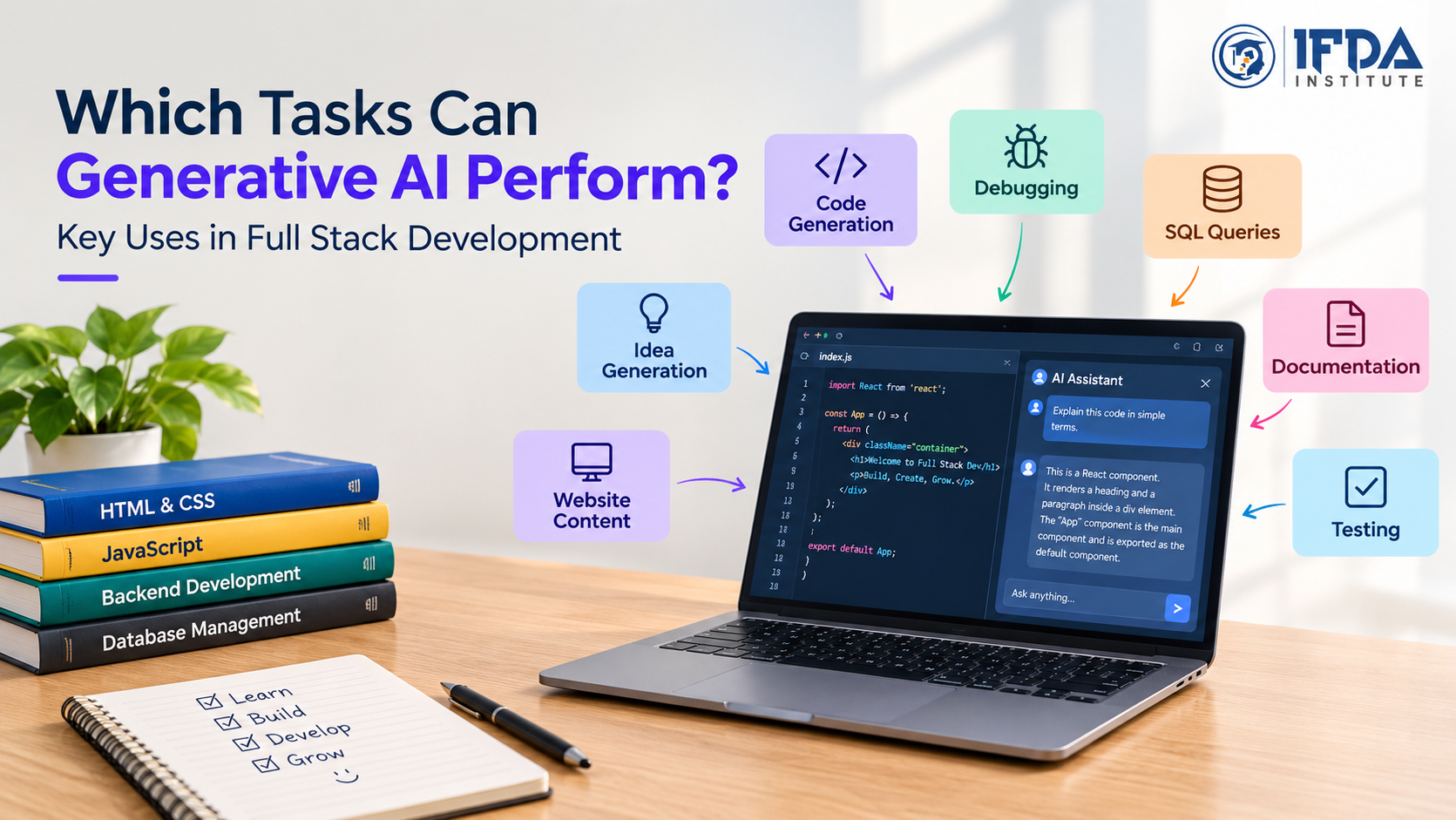
Generative AI has become one of the pivotal points in modern technology, especially for content, software, data-driven processes, and other products that involve human creative interaction. Unlike typical software solutions that follow strict instruction sets, AI can generate new ideas and information based on the input it receives. This technology can create text, code, images, ideas, summaries, and various other digital content forms.
For students who are learning full-stack development, getting to know the actual possibilities offered by generative AI is critical. It will not replace the need to study programming fundamentals but can significantly simplify the process of building a website or application.
What is generative AI?
In short, generative AI is a group of modern artificial intelligence tools that can create new content pieces based on a prompt provided by a user. Such solutions can take text, code, images, video, audio, or any other data type as an input. For instance, one can describe what they want to see in a website design in natural language and receive a snippet of code to review and apply.
That makes generative AI a powerful assistant that goes beyond simple automation and can genuinely help one accomplish more.
What tasks can be performed using generative AI?
There is a long list of common tasks that one can use generative AI for. However, one should always remember that the effectiveness of such tools depends on the accuracy of the prompt, the complexity of the given task, and how easy it is to verify the result.
1. Generating and Explaining Code
One of the most promising uses of generative AI is software development, where AI can generate sample code according to specified requirements.
For instance, students who are to develop a program in JavaScript may ask AI to provide code for a specific function, such as email validation, or explain the given strings of code.
This can be a great help for students who have trouble grasping programming logic and understanding how a given piece of code woworks buthould not replace the need to comprehend the generated code.
2. Debugging Programming Problems
Debugging is a necessary and time-consuming part of software development, during which programmers seek and eliminate errors in their code.
Explain bugs: students may use generative AI to understand error messages, what issues in the code they may indicate, and how these issues can be resolved.
For example, students can copy an error message and the code snippet that caused the error and ask AI for help.
Similarly, debugging can become significantly easier for those who study programming languages like JavaScript, Python, or others.
However, one should always test the proposed solution, as suggestions may sometimes be completely wrong.
3. Writing SQL Queries
Full-stack development often employs databases, and generative AI can help with database-related operations as well.
For instance, if a learner asks for a request to find customers who have made more than X orders, AI can provide an SQL query with an explanation.
This can be helpful in understanding database-related concepts, but students should have at least some understanding of tables, their relationships, filtering, joins, and other database concepts.
4. Creating Documentation
Documenting code and projects is an important but often overlooked part of software development.
Generative AI can help developers create documentation for functions, APIs, features, installation, and technical processes.
This can help students, who are learning to build full-stack applications, to document their own projects and better explain their features and functions.
5. Generating Test Cases
Software products must go through a testing process before launch, and developers should think of multiple cases for testing.
Using the above example, a website might have a registration form that requires users to enter personal information and email.
AI can help come up with test cases for valid and invalid information, additional requirements (such as using a specific email provider), weak and strong passwords, and other conditions.
This can help learners realize that testing goes beyond simply verifying that a feature or product works.
How Can Generative AI Help Full-Stack Developers?
The most significant benefit that generative AI can bring to developers is not limited to just the ability to generate code. The main advantage is the ability to use it for various purposes during the development process.
A developer can benefit from using generative AI for learning, brainstorming, coding assistance, debugging, documentation, testing, and understanding of new concepts. Such technologies can make development easier if a person knows how to use them correctly.
In addition, such programs can act as teaching assistants for those who want to learn how to develop software. Instead of just asking for answers, they can ask the AI assistant to talk them through the solution, show an example, find a difference between similar cases, or even explain mistakes.
Does Generative AI Replace Full-Stack Developers?
Although generative AI can perform some routine tasks for developers, creating applications is still largely dependent on people. In other words, the implementation of various aspects of the project is automated, but the need for a developer who will understand what exactly needs to be done remains relevant.
A professional in the field of full-stack development must know how to properly address each nuance of the project, from understanding the requirements to choosing the programming languages and tools to be used, designing the application's architecture, working with databases, protecting information, testing, and writing code. Each of these steps requires human interaction, which does not allow AI to replace a person in the development process.
Moreover, the code written with the help of generative AI requires auditing by a specialist to ensure that everything is implemented correctly and nothing is wrong. This way, AI helps to simplify and speed up the process, but the role of a developer in the full-stack development field is not replaced.
What Should Full-Stack Students Learn Alongside Generative AI?
If one wants to learn how to develop software, studying programming languages and fundamental technologies in this field is paramount. First, one needs to have a certain amount of knowledge about web design generation, databases, and APIs, as well as front-end and back-end version control systems and basic knowledge of web security.
With this set of skills, the use of generative AI for development will be much more productive and time-saving. However, it is necessary to approach such technologies with an awareness of programming and the ability to control and audit the code.
Thus, the assistant should be used not only to generate code on its own but also to study programming, explore new concepts, find explanations, study mistakes, and debug code.
Conclusion
To conclude, generative AI can be used for lots of various tasks related to coding. One can use it for writing code, studying programming languages and concepts, debugging, writing SQL generative queries, documentation, testing, and website development. For students in the field of full-stack development, such technologies as generative AI can be extremely helpful and time-saving.
However, the most valuable skill is understanding how technology works. Generative AI can suggest and assist, but a competent developer needs knowledge to assess suggestions and develop reliable digital products.
For this reason, learning full-stack development along with responsible use of generative AI can help students understand how to build applications and how modern AI tools can assist the development.

.webp)